

Does the law have a sense of humour? Justice Albie Sachs asked this in Laugh It Off Promotions CC v South African Breweries International (Finance) BV in 2005. More than twenty years later, the question resurfaced before the Versailles Court of Appeal in France in a dispute between Hermès International and Hermès Sellier (collectively, Hermès) and retailer Sherine Orient (“Orient”).
Orient sold handbags bearing slogans translated as “While waiting for my Birkin” and “My Hermès is at home”.
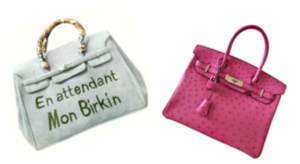
The phrases played on the Birkin’s reputation as an expensive, difficult to obtain, luxury status symbol. The joke was that consumers could carry a substitute bag while waiting for the real thing, or a missing Hermès bag could supposedly be explained as being at home. Hermès, however, was not amused.
When a luxury joke goes to court
Hermès took issue with the handbags sold by Orient in-store and on Instagram bearing these phrases. In Hermès’ view, the slogans did more than make light-hearted references to its famous handbags. They appropriated the attraction and prestige of the HERMÈS and BIRKIN marks to help market and sell competing products.
When demands to cease the production, marketing and sale of the bags went unheeded, Hermès instituted proceedings alleging infringement of its copyright, a three-dimensional trade mark relating to the Birkin bag’s lock, and its registered HERMÈS and BIRKIN word marks.
At first instance, Hermès succeeded on its copyright and shape mark infringement claims , but its claim for infringement of the word marks failed. The court considered each slogan as a whole and found that consumers were unlikely to be confused as to the origin of the bags.
Hermès appealed.
The question on appeal
The Court of Appeal found that HERMÈS and BIRKIN remained immediately recognisable within the slogans and retained what the court described as their “pouvoir attractif” or attractive force. The phrases linked the bags being sold directly to the famous marks and the products for which they were protected. Although the Court of Appeal accepted that the slogans were humorous and consumers were unlikely to think that the handbags originated from Hermès, it found that the trader was taking advantage of the marks’ reputation and the investment behind them. The humour worked precisely because consumers recognised the brand.
The Court stated that:
“If the message in the form of a touch of humour, conveyed by the phrases “Waiting for my Birkin” and “My Hermès is at home”, leaves little doubt that the products do not come from the Hermès companies, the fact remains that these actions harm the interests of the owner of the HERMÈS and BIRKIN trademarks, in that they aim to take advantage of their reputation, thus diverting the investments he has made in them and damaging his image」
[Translated from French to English].
The slogans therefore drew on the reputation of the marks to attract attention and assist in selling the products.
What if the Birkin dispute reached a South African court?
South African owners of registered trade marks may rely on section 34(1)(c) of the Trade Marks Act 194 of 1993, known as the “anti-dilution” provision. It prohibits the unauthorised use of a mark, in relation to any products or services, which is identical or similar if the use of infringing mark would likely take unfair advantage of, or be detrimental to, the distinctive character or repute of the registered mark, even if there is no likelihood of confusion or deception.
RELATED – Beyond the Logo: Protecting Your Product Get-Up
Given the international reputation of HERMÈS and BIRKIN, Hermès may well succeed in establishing that its marks are well known. The key question then would be whether Orient’s use unfairly exploited or harmed that reputation. Orient, in turn, could invoke the right to freedom of expression in section 16 of the Constitution. South Africa’s Constitutional Court considered parody in Laugh It Off Promotions CC v South African Breweries International (Finance) BV 2006 (1) SA 144 (CC). The case concerned T-shirts that played on SAB’s BLACK LABEL branding. The Court stressed the need to balance expressive use of a trade mark against the owner’s right not to suffer undue detriment. Sachs J observed that good parody is both original and parasitic: it must borrow enough for the audience to recognise the original, but too much borrowing may leave too little originality. Laugh It Off Promotions ultimately succeeded because SAB failed to prove actual economic detriment.
When the joke is told by a competitor
The distinction between parody and commercial advantage was considered by the Appeal Committee of the Advertising Standards Authority of South Africa (ARB) in a complaint made by South African Airways (SAA) against Comair Ltd, trading as Kulula.com (Kulula). Kulula had advertised a green aeroplane with an adapted South African flag on its tail and the words “THE MOST SOUTH AFRICAN AIRWAYS” on the fuselage, in a style reminiscent of SAA. The Committee warned that an advertiser who relies on parody has, by definition, taken advantage of someone else’s goodwill, and that “too easy an acceptance that an advertisement constitutes parody, will mean that a product or service whose goodwill has been exploited in the advertisement will not be protected.” It also held that the parody must be clear from the advertisement itself. A track record of humorous advertising, or a punchline that only lands in a later phase of the campaign, is not enough.
Most importantly, the Committee drew a clear distinction between a parody artist and a competitor. It noted that Kulula, “a competitor of SAA, was using SAA’s trade symbols to promote its own airline”, which was “quite different to the situation in Laugh it Off, where the organisation was a non-competitor parody artist”. The Committee concluded that the advertisement, “although apparently an attempt at parody, did not walk the line finely enough”, and found that it took unfair advantage of SAA’s goodwill in breach of the Code.
The ARB took a similar approach in 2022, in a complaint by Nando’s against television commercials for Pedros Flame Grilled Chicken. In each commercial, a character starts to say “Nan…” while describing peri-peri chicken, and is cut off and corrected with “Pedros!”. The ARB accepted that, in the context of flame-grilled chicken, even the partial reference “Nan” was enough to bring the Nando’s brand to mind.
The ARB found that, instead of promoting the merits of its own product, Pedros had “simply set up that they are an alternative to Nando’s”, riding off the back of a reputation Nando’s had spent years and billions of rands building. It held that the commercials were not parodies because they did not imitate the style of Nando’s advertising but simply referenced the brand. The ARB also took Pedros’ position as a competitor into account. Pedros was “a relatively new entrant seeking to challenge the market”, and the primary intention of the commercials was “not to amuse but to present the brand as an alternative to Nandos. Any resultant amusement is incidental」
Notably, the ARB stressed that exploitation of advertising goodwill does not require proof that the brand owner suffered harm. It also found that the commercials disparaged Nando’s, warning against “the trap of thinking that because Nando’s is the established leader in the category, and Pedros is the feisty newcomer… that Pedros should be protected at the expense of Nando’s brand」
In the Birkin dispute, like Kulula and Pedros, Orient was not a satirist commenting on a brand from the outside. It was a trader using famous marks on the very goods for which those marks are registered, to sell its own products. On the reasoning in Kulula と Pedros, a South African court or regulator may well be slow to accept that the joke excuses that use.
Parody and IP Infringement: Key takeaways
- Humour is not a defence on its own. Both the Versailles Court of Appeal and the ARB accepted the attempt at humour, and both still found against the trader.
- No confusion is needed. A well-known mark can be infringed even where consumers know the products do not come from the brand owner.
- Parody must walk a fine line. It must take enough to bring the original to mind but be creative enough to be different.
- Competitors get less room. Using a rival’s marks to promote competing products is less likely to qualify as parody, particularly where the aim is to present the product as an alternative and humour is merely incidental.
- Small changes to a mark or embedding it in a witty slogan may not avoid liability. The joke must be clear on its face. An advertiser cannot rely on its reputation for humour, or on a later advertisement, to explain the joke.
- Brand owners should register and enforce. Registered marks, copyright and shape marks give owners several routes to act.
 Japanese
 English
 Chinese